
What types of door hinge are there? uPVC and composite doors use two main types: flag hinges and butt hinges. Butt hinges come flat, angled or rebated to suit the frame, and composite doors use heavy-duty versions. Most modern hinges are 2D or 3D adjustable, which means a dropped door can often be fixed with an Allen key rather than a new hinge.
Use the pictures below to work out which one you have, then check the measurements before you order.
Door Hinge Types With Pictures
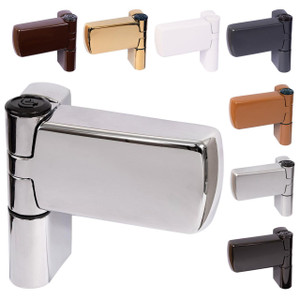
Flag hinges
The most common hinge on uPVC front, back and French doors.
- A chunky body on a vertical pin
- A flat plate (the “flag”) that screws into the door or frame
- Often caps at the top or bottom of the pin, covering the adjusters
Also called flap hinges. T hinges work the same way, with the door plate in the middle of the hinge.
Shop flag hinges
Butt hinges (flat or angled)
Two narrow leaves joined by a knuckle, fixed to the edges of the door and frame.
- Sits in the gap between door and frame
- Flat for flat frames, angled for angled frames
- Angles vary by brand: our range includes 0°, 5°, 13°, 15° and 45° versions
Sometimes called pencil or cylinder hinges, after the shape of the knuckle.
Shop butt hinges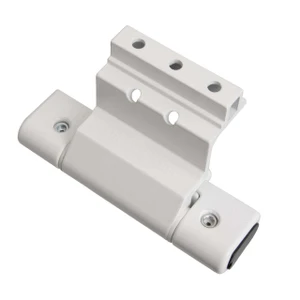
Rebated butt hinges
For doors that overlap the frame instead of sitting flush with it.
- Stepped leaves to fit the rebate
- Usually sit in the eurogroove (the channel round the door edge) on bevelled or chamfered profiles
- Check the rebate size on the listing
Also called pendulum, neon or paddock hinges.
Shop rebated hinges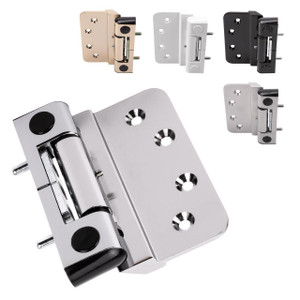
Composite door hinges
Heavy-duty hinges for heavier composite doors.
- 2D or 3D adjustable butt hinges, rebated or side-fix
- Rated for the weight of a composite door, typically 90–100kg over three hinges
- Examples: Fab & Fix Haven (2D), Trojan 3D, ERA Laird Challenger 3D
Some composite doors use flag hinges instead; see the question below.
Shop composite hingesWhich Type of Hinge Do I Have?
Is your door uPVC or composite?
Tip: knock on the door. A composite door sounds solid and dull; a uPVC door sounds lighter and more hollow.
Door Hinge Types Compared
| Type | How to recognise it | Found on | Adjustment |
|---|---|---|---|
| Flag hinge | Body on a pin, with a flat plate (the flag) | Most uPVC doors, some composite doors | Usually 3D (height, side to side and compression) |
| Flat or angled butt hinge | Two narrow leaves and a knuckle, in the gap | uPVC doors, especially older ones | 2D or 3D, check the listing; some older ones adjust side to side only |
| Rebated butt hinge | Stepped leaves, door overlaps the frame, often sits in the eurogroove | Rebated uPVC door profiles | 2D or 3D, check the listing |
| Composite door hinge | Heavy-duty butt hinge, rebated or side-fix, with a weight rating | Composite doors | 2D or 3D, check the listing |
2D or 3D Adjustable?
2D adjustable
Adjusts in two directions. Which two varies by hinge: some give side to side and compression, others side to side and height, and some older butt hinges combine movements in one eccentric pin. Check what your model offers rather than assuming.
3D adjustable
Adjusts height, side to side and compression independently. Found on most modern flag hinges and on composite door hinges such as Trojan 3D and ERA Challenger 3D.
How to tell: count the adjusters. A 3D hinge normally has an adjustment point at the top or bottom of the pin (often under a cap) as well as on the body. If the only adjusters are on the body, it is probably 2D. Side to side is the one that lifts a dropped lock-side corner back into line; height alone won’t cure it. If the hinges can’t reach, the door itself has gone out of square and needs toe and heeling (see below).
Replace or Adjust? Check This First
| What you see | What to do |
|---|---|
| The door catches the frame or is stiff to lock, but the hinges look fine | Adjust. The door has dropped. Adjustable hinges will usually lift it back into line. |
| A hinge is cracked, bent or rusted, or the pin is worn | Replace that hinge, and check the others for the same wear. |
| You’ve adjusted as far as it goes and the door still drops | Replace. The hinges are worn out. |
| The lock side has dropped but the hinges are sound and already at the limit (glazed or panelled uPVC door) | Toe and heel the glass or panel. The sash has gone out of square, not the hinges. See the section below. |
| The screws turn but won’t tighten | Fix the screw holes, not the hinge. Use repair screws in the same holes. |
Don’t leave a dropped door. Leaning on the handle to lock it puts extra force through the lock, and that is one of the main reasons multipoint lock gearboxes wear out.
What to Check Before You Order
- Type. Flag, flat or angled butt, rebated, or composite: use the pictures above.
- Length. Measure the hinge from top to bottom with the door closed. Common butt hinge lengths are 100mm and 115mm; flag hinges vary by model (ERA Nexus, for example, comes in 85mm and 100mm).
- Fixing centres. Measure between the centres of the screw holes on the frame side, then again on the door side.
- Fixings. Note how many screws there are on each side and whether they are standard screws or hex-headed.
- Angle, rebate or upstand. For butt hinges, check flat or angled. For flag hinges, measure the step (rebate or upstand) the hinge bridges: 16mm, 19mm, 21mm and 22mm are the usual sizes, with 19mm the most common. If you’re between sizes, a smaller hinge can be brought up with packers (1mm, 2mm or 6mm for the Trojan Patriot Plus).
- Gap. Measure the gap between the door and the frame at the hinge. This sets how deep the hinge body needs to be.
- Handing and colour. Stand outside facing the door. If the hinges are on your left, it is a left-hand door. Most hinges are universal, but some are made in left and right hand versions; if the listing doesn’t mention handing, it fits either way. Note the colour too.
- How many. Count the hinges on the door and check whether the listing is for one hinge or a pack.
Measure a hinge that is still fitted and straight, not one you have just taken off. A hinge that has been forced is rarely the shape it started as. Before you remove anything, photograph the hinge open and closed, including both the door and frame parts, and look for a brand name or code on it. It makes matching far easier.
Which Brands Fit Which Doors?
Older uPVC doors: usually butt hinges
Doors from the 1990s and 2000s often carry butt hinges. Common brands on our shelves include Avocet, WMS, Mila Ideal and ERA Laird Challenger.
Newer uPVC doors: usually flag hinges
Most doors fitted in the last 15 years or so use flag hinges. Look for Avocet Triad, ERA Nexus (common on B&Q and Wickes doors), ERA Maxim, Mila Evolution, Yale Neon and Trojan Patriot Plus.
A brand name on the hinge is a good start, but the length, fixing centres and rebate still have to match. Rebated hinges are being phased out by some makers, so if yours is an older pattern, send us a photo and we’ll find the closest current replacement.
Adjust Before You Replace
Height
Raises or lowers the door. Helps when a door has dropped and catches the frame or threshold.
Side to side
Moves the door towards the hinge or lock side, to even out the gap and line up the lock.
Compression
Pulls the door in against the seals or lets it out. Helps with draughts or a stiff handle.
Most hinges adjust with the door still hung. Make small turns on each hinge in turn and check the door after each one. The adjusters are usually under caps on the hinge and the method varies by model, so check the instructions for your hinge. For Trojan 3D composite hinges there is a dedicated adjustment tool (6mm hex plus 4mm Allen key). Replace hinges that are cracked, badly worn or won’t hold their adjustment.
Dropped Lock Side? Try Toe and Heeling First
On a glazed or panelled uPVC door, the hinges are not the only thing holding the door square. The glass unit or panel is rigid, and small plastic packers between it and the frame are what stop the sash sagging into a parallelogram. If those packers have slipped, been left out or compressed, the lock-side corner drops and no amount of hinge adjustment will hold it. Repositioning the packers so the glass pushes the sash back into square is called toe and heeling. It costs a few pence in packers and often fixes a “dropped” door that looked like it needed new hinges.
When it applies
- uPVC doors with a glass unit or a uPVC panel held in by beads
- The door has dropped at the lock side, the hinges are sound and adjusting them hasn’t cured it
- Not composite doors: the slab is solid, so there is nothing to pack
Where the packers go
Think of a diagonal from the bottom hinge-side corner to the top lock-side corner. Packers at those two points lift the lock side. A packer on the hinge side near the top stops the unit sliding across. Packers go against the edge of the glass, on top of the glazing bridges or spacers, never directly on the uPVC.
What you need
- Plastic glazing packers in a mix of thicknesses (1–6mm)
- A glazing shovel or stiff putty knife to lift the beads
- Glass suction cups and a second person for a large unit
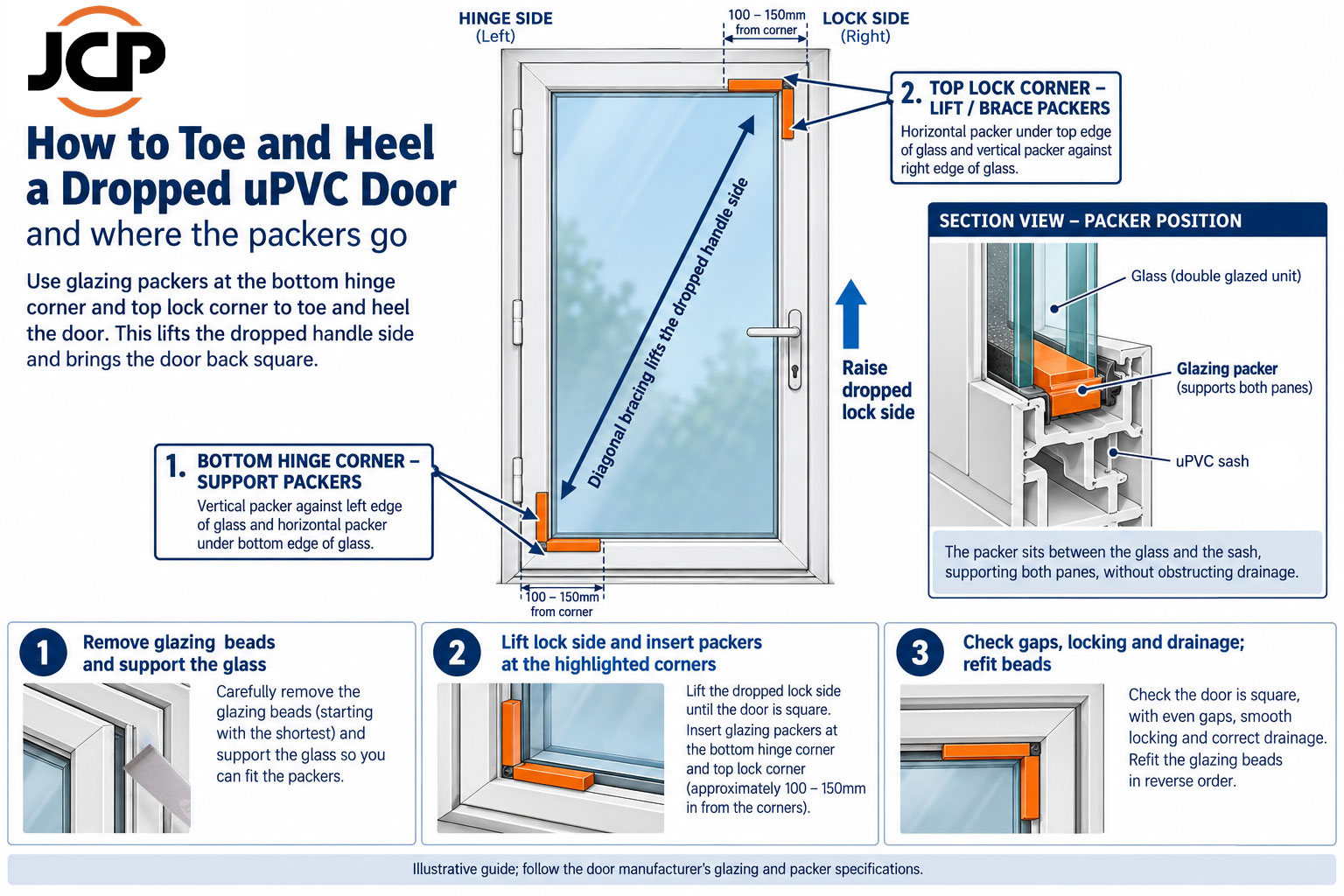
- Open the door and support it underneath so it is sitting square to the frame. Mark on the frame where the top lock-side corner should be.
- Remove the beads. On most uPVC doors they are on the inside. Start with a long bead: push the glazing shovel into the join between bead and frame at the middle, lever gently until it pops, then work along. Do the long beads first, then the short ones, and note which went where.
- Ease the glass out slightly from the bottom lock-side corner so you can reach the packers. The unit only needs to move a few millimetres; keep it supported and don’t let it lean. Note where the existing packers are.
- Pack the bottom hinge-side corner. Slide packers between the bottom of the glass and the glazing bridge, close to the hinge side, until the unit sits firmly.
- Pack the top lock-side corner. Lift the lock-side corner of the sash up to your mark and slide packers in above the glass at that corner. The glass should now be bracing the sash on the diagonal.
- Add side packers on the hinge side near the top and the lock side near the bottom if there is room, so the unit can’t drift.
- Check before you bead up. Close the door gently. It should clear the frame, the gaps should be even and the handle should lift without force. Adjust the packing if not.
- Refit the beads in reverse order: short beads first, then long. Push them home by hand, tapping with a soft mallet if needed, and check the glass isn’t being pinched. Fine-tune with the hinge adjusters afterwards.
Take care: only use plastic glazing packers, never wood or metal, and never pack so hard the glass is under strain. Packers should sit snug, not forced. If the beads are on the outside, the unit is very large, or you are not confident handling glass, get a window fitter to do it. Toe and heeling a sliding patio door or bifold is a different job.
Tools You’ll Need
To adjust
Allen keys. 4mm, 5mm and 6mm cover most hinges; Trojan 3D composite hinges also need a 6mm hex socket, or the Trojan spanner above.
To replace
A Pozidriv screwdriver, plus Torx bits (T20 and T25 are common on uPVC hinge screws). Repair screws if the old holes have worn.
To support the door
Wedges or packers to take the weight off the hinges while you work. For a composite door, a second pair of hands.
Replacing a Door Hinge
- Check you have the right hinges before you start: same type, length, angle or rebate, handing and colour.
- Open the door and support it underneath with wedges or packers.
- Change one hinge at a time, so the door stays hung and lined up.
- Remove the old hinge. On some hinges a small security grub screw stops the pin being removed; undo that first.
- Fit the new hinge in the same position and the same way round, using the existing holes where they line up. If a screw spins, use a repair screw in the same hole.
- Repeat for the other hinges. If one has failed, the others have usually had the same wear.
- Remove the supports, close the door slowly and check it clears the frame and locks without force.
- Adjust the new hinges if needed, then check the locking again.
Hinges and Security
Hinges are part of a door’s security, not just its movement. On an outward-opening door the hinge knuckles face outside, so the hinge side deserves the same attention as the lock side. Look for:
PAS 24 rated hinges
Tested as part of a door set against forced entry. The Trojan Patriot Plus flag hinge is a PAS 24 design.
Anti-lift pins
Stop the door being lifted off its hinges if the pins or knuckles are attacked. Fitted to hinges such as the Mila Evolution and Fab & Fix Haven.
Security grub screws
A small screw that locks the hinge pin in place so it can’t be driven out from outside.
If security is the reason you’re replacing hinges, check the listing for a stated standard rather than assuming, and it’s worth looking at your euro cylinder at the same time.
Frequently Asked Questions
What are the main types of uPVC door hinge?
There are two main types: flag hinges and butt hinges. Butt hinges come flat, angled or rebated to suit the frame. Composite doors use heavy-duty versions, usually 2D or 3D adjustable butt hinges.
How do I know which hinge I have?
Open the door and look at the hinge from the hinge side. A flag hinge has a chunky body on a pin with a flat plate (the flag) screwed into the door or frame. A butt hinge has two narrow leaves joined by a knuckle, fixed to the edges of the door and frame. Photograph it open and closed and compare it with the pictures on this page.
Is my hinge 2D or 3D adjustable?
Count the independent adjusters. A 3D hinge gives height, side to side and compression separately, with the height adjuster usually under a cap at one end of the pin. A 2D hinge gives two of the three, and which two varies by model. If the only adjusters are on the body of the hinge, it is probably 2D.
Can I adjust the hinges with the door still hung?
Yes, on most modern hinges. Remove the cover caps, make a small turn on each hinge in turn with the right size Allen key, and check the door after each adjustment. You only need to support the door if you are removing a hinge.
What size Allen key do I need?
It varies by model. 4mm, 5mm and 6mm cover most uPVC and composite door hinges. Trojan 3D composite hinges use a 6mm hex socket for height and side to side and a 4mm Allen key for compression, both built into the Trojan adjustment tool.
Are uPVC door hinges universal?
No. Hinges differ in type, length, fixing centres, profile angle, rebate size and handing. Some individual hinges are sold as universal and fit doors opening either way, but the type and measurements still have to match. Match your old hinge, or send us a photo and we’ll match it for you.
Are composite door hinges different from uPVC door hinges?
Composite doors are much heavier, so they need hinges rated to carry the weight, typically 90–100kg over three hinges. Many use 2D or 3D adjustable butt hinges, rebated or side-fix. Don’t fit a lighter uPVC hinge to a composite door just because the holes line up; the extra weight usually shows up as a dropped door within a season.
How do I tell a flat butt hinge from an angled one?
Look down on the open hinge from above. If the leaf sits square to the pin it is flat (0°); if it is set at an angle it is angled. Angles vary by brand and frame system, so compare it with the product options.
What is a rebated hinge?
A rebated (or pendulum) hinge is made for doors that overlap the frame rather than sitting flush with it. If the door face sits in front of the frame and leaves a small step, or the hinge sits in the groove round the edge of the door rather than on the face, you probably need a rebated hinge.
What is a flag hinge rebate or upstand?
It is the step the hinge bridges between the door and the frame. Flag hinge rebates usually come in 16mm, 19mm, 21mm or 22mm, with 19mm the most common. If you are unsure, choose the smaller size and use packers to make up the difference.
Do I need top, middle and bottom hinge versions?
Usually not; most hinges are the same at every position. A few models are supplied as top, middle and bottom versions, or as two-part and three-part hinges, so check the listing and buy a full set of the same pattern.
How many hinges does a uPVC door have?
Most uPVC and composite front and back doors have three hinges. Count yours before ordering and check whether the listing is for one hinge or a pack.
Should I adjust or replace my door hinges?
If the hinges are sound and the door has just dropped or is catching, try adjusting them first. Replace hinges that are cracked, badly worn, seized or won’t hold their adjustment, or if you have adjusted as far as they go and the door still drops.
What is toe and heeling?
Repositioning the plastic packers between the glass or panel and the uPVC sash so the unit braces the door square. On a glazed uPVC door the glass is what stops the sash sagging; if the packers have slipped, the lock side drops even when the hinges are fine. Packing the bottom hinge-side corner and the top lock-side corner lifts it back. It only applies to glazed or panelled uPVC doors, not composite doors.
Can I replace just one hinge?
You can if an exact match is available and the others are in good condition. Check the replacement is the same pattern and depth as the ones staying put, as a hinge that sits even slightly differently will pull the door out of line. If two of three have failed, replace the set.
What are hinge packers for?
Packers sit behind a hinge to change its position, for example to bring a door closer to the frame or to make up a larger rebate. They are made for particular hinges, such as the Trojan Patriot Plus packers in 1mm, 2mm and 6mm, so they are not universal.
Browse all door hinges: flag hinges, butt hinges and composite door hinges. Window hinges are different: see our window hinges and friction stays.
Send us photos of the hinge open and closed, with a tape measure alongside, and we’ll match it for you.
Monday to Friday, 8:30–12:30 and 13:00–15:30